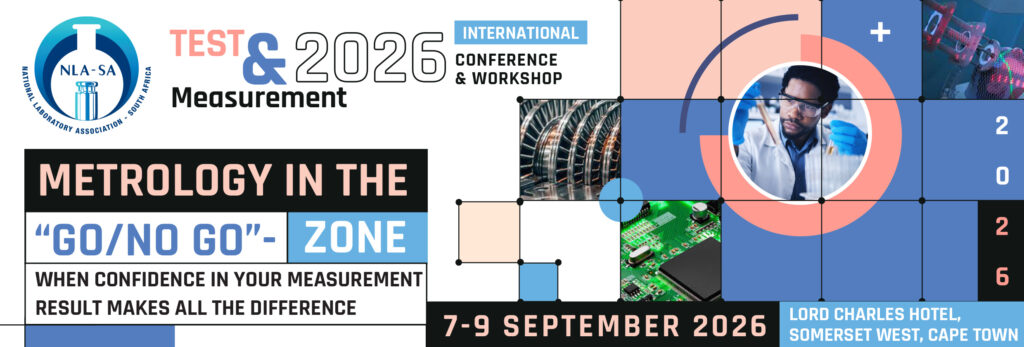
“Knowledge is an unending adventure at the edge of uncertainty” – Jacob Bronowski
It is not only this Polish-British mathematician and philosopher who was the writer and presenter of the BBC television documentary series “The Ascent of Man” who made profound statements about uncertainty. There is also Albert Einstein who said, “As far as the laws of mathematics refer to reality, they are not certain; and as far as they are certain, they do not refer to reality” and Richard Feynman said “I can live with doubt and uncertainty and not knowing. I think it is much more interesting to live not knowing than to have answers that might be wrong.” Even the actor Charlie Sheen very succinctly stated “Uncertainty is a sign of humility and humility is just the ability or willingness to learn.”
Metrology is essential for decision-making by providing the accurate, reliable data needed for informed choices in science, industry, and everyday life. It ensures quality control, allows for fair trade, and provides the foundation for innovation by enabling scientists, engineers, and managers to understand and trust the measurements and data they use for everything from product design to policy implementation. Some examples of the critical use of measurement results in decision making include the geometric tolerances for flatness, perpendicularity, and position; and the specific ranges for hydraulic manifolds, such as + 0.0000/0.0005 mm for certain components in aerospace engineering. These tolerances are critical for ensuring parts like turbine blades and landing gear are safe, reliable, and perform correctly, particularly in structural alignments and aerodynamic performance.
In radiation therapy, accurate dosing is crucial for maximising the chance of destroying cancer cells while minimising damage to surrounding healthy tissue. A slight deviation from the planned dose can have severe consequences, including reduced effectiveness against the tumour or dangerous side effects caused by overexposure. For some tumours, a small change in dosage can have a large effect on the outcome. For example, a 5% underdose could result in a 10% to 20% reduction in the probability of controlling the tumour. An underdose could leave “cold spots” – areas within the tumour that receive an inadequate dose – which allows cancer cells to survive andpotentially cause the disease to return. Overdosing the chest area can cause long-term problems, including lung damage and heart problems. Misadministration of radiation to vital organs, such as the brain or spinal cord, can lead to devastating injuries, including stroke-like symptoms, hearing loss, or paralysis.
Selenium is essential for overall health because it is a critical trace element that supports several vital bodily functions, including proper thyroid function, immune system support, DNA synthesis, and reproduction. It also acts as a powerful antioxidant, protecting cells from damage caused by oxidative stress. The recommended daily nutritional level of selenium varies by age, with adults and children over 13 needing 55 microgram (μg). While selenium is essential, high doses can be toxic. It is important to stay within the recommended daily levels. Toxic levels of selenium can result from an intake exceeding 400 to 700 microgram (μg) per day, causing symptoms such as nausea, diarrhoea, hair loss, nail problems, and a distinctive garlic-like odour to the breath. Chronic or acute toxicity can also lead to more severe effects like dermatitis, fatigue, irritability, and peripheral neuropathy. Treatment involves immediately stopping the source of excessive intake and seeking medical advice, as there is no antidote
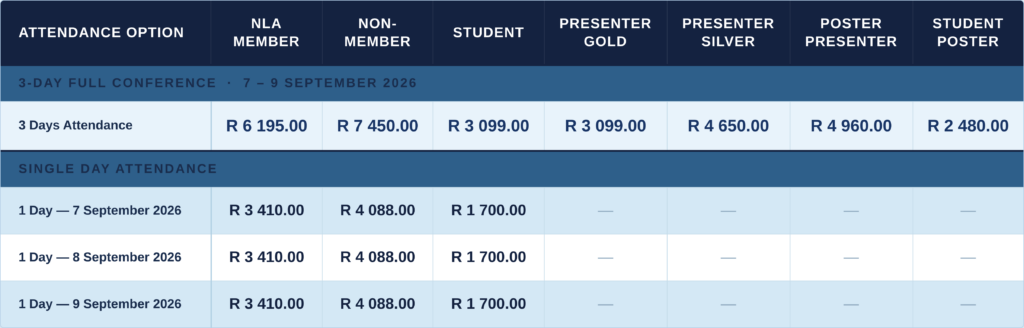
Please note the following important registration information:
Please note: If you are a presenter and have received acceptance of your abstract, please register as a Gold Presenter. You will only be moved to a Silver Presenter pricing status if your manuscript is not submitted by the 31 July 2026 deadline.
Terms and Conditions
Prices in Rand are excluding 15% VAT.
No accommodation is included in the prices.
Prices are complete and no refunds will apply for non-attendance.
Payment must be received in full before registration will be confirmed.
Multiple attendances on a single full 3-day attendance registration will not be allowed. No exceptions.
Cancellations before 31 August 2026 will be entitled to an 80% refund. After this date, not refunds will be allowed.
Registrations can be transferred to an alternate delegate at a 10% substitution fee.